The Humble Checklist: Implementing Change with AyniHealth Catalyst
The Humble Checklist: Implementing Change with AyniHealth Catalyst
We often focus our resources on the latest technical hardware, yet data suggests our priorities might be misplaced. An FMEA (Failure Mode and Effects Analysis) of intensity-modulated radiotherapy conducted by the AAPM Task Group 100 revealed a startling reality: only 11% of risks were classified as failures due to software or hardware.
The remaining 89% of patient safety incidents stem from non-equipment failures—primarily human error, lack of standardisation, and poor communication.
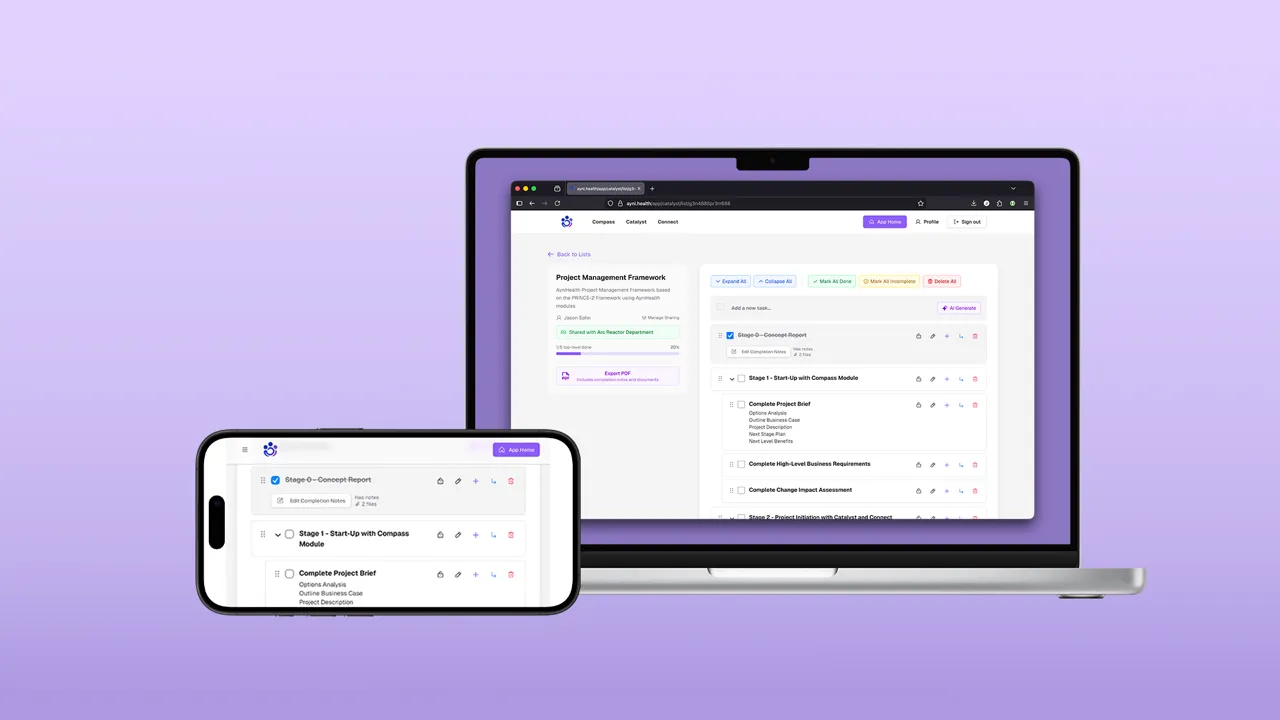
At AyniHealth, we believe the key to bridging this safety gap lies in the second pillar of our three-step framework: Align. Implement. Sustain. Specifically, we focus on the Implement phase through our AyniHealth Catalyst approach, which champions the humble but transformative power of the checklist.
AyniHealth Catalyst: Making Change Stick
The AyniHealth Catalyst is designed to take the guesswork out of complex clinical transitions. Our framework focuses on your two most important resources: people and equipment.
Research across clinical and operational domains highlights that checklists are transformative tools for healthcare project management and delivery. By serving as cognitive aids and standardising complex workflows, they significantly reduce medical errors, enhance team communication, and improve patient outcomes. Our dynamic checklists are simple and easy to use and are designed for use in healthcare by busy teams like yours. If you already use another system, we can replicate this in a matter of seconds.
Benefits in Healthcare Project Management
In the context of managing healthcare projects—such as clinical trials, new technology implementations, or system upgrades—checklists ensure accountability and consistency across the project lifecycle.
- Consistency and Accountability: They keep teams aligned on key milestones, from initiation (e.g., obtaining ethics approval) to conclusion (e.g., locking databases and archiving documents).
- Knowledge Retention: Well-designed checklists help disseminate information widely and retain organisational knowledge, ensuring that evidence-based best practices are consistently translated into daily practice regardless of staff turnover.
- Reduced Complexity: High-pressure environments increase cognitive load; checklists act as public frameworks that help managers navigate these intricacies without overlooking critical procedural requirements.
- Standardised Data Collection: Operationally, checklists are highly effective at registering the occurrence of incidents, tasks, or problems, which allows for easier data extraction and pattern detection to improve future project performance.
Implementation Barriers and Success Factors
Research indicates that the quality of implementation is as critical as the checklist itself.
- The "Compliance Gap": While checklists are often widely accepted in policy, a gap exists between "work as imagined" and "work as done." Actual use is rarely monitored, and senior managers often assume compliance without verification.
- Stakeholder Engagement: Effective checklists are rarely developed in isolation. Involving clinicians, nurses, and administrative staff in the design process ensures they are embraced and effectively utilised.
- Complexity vs. Usability: Effective checklists must be manageable and precise. Excessively long or overly detailed lists can hinder efficiency rather than help it.
Benefits in Healthcare Project Delivery
Studies on clinical delivery—most notably the WHO Surgical Safety Checklist—provide concrete evidence of the efficacy of these tools in reducing harm.
- Reduction in Complications and Mortality: A landmark study across eight hospitals showed that a two-minute checklist reduced surgical complications and deaths by one-third. Systematic reviews confirm significant reductions in postoperative complications and 30-day mortality rates when checklists are implemented.
- Improved Human Factors: Beyond simple task completion, checklists encourage behaviour change by fostering an atmosphere of effective communication and shared mental models among interdisciplinary teams.
- Error Prevention: Checklists have been shown to reduce equipment errors by 48.6% to 60.7% and successfully mitigate the risk of central line-associated bloodstream infections in intensive care units.
- Economic and Operational Efficiency: In delivery settings, checklists can influence work processes to reduce mean operating room disposable costs (e.g., a reported $70 reduction per operation) without increasing overall operation time.
Is Your Team Ready to Align and Implement?
Change doesn't have to be a source of delay or resource drain. By focusing on the human factors that contribute to nearly 90% of risks, you can optimise your most precious resource: time. AyniHealth is designed to help your team stay aligned and on track, ultimately saving valuable time and resources.
Are you ready to see how the AyniHealth framework can save your department time and money?
References
- American Journal of Roentgenology (AJR, 2024/2025 Update): “A Checklist Manifesto: Effectiveness of Checklist Use in Hands-On Simulation Examining Competency in Contrast Reaction Management.” — The checklist group achieved 85.1% accuracy vs. 64.8% for the control group in managing rare medical emergencies.
- The Surgery Journal / Dove Press (2025): “Impact of Implementing Checklist Management Combined with SOP on Nursing Coordination.” — Combining checklists with Standard Operating Procedures significantly reduced human variability and clinical errors in complex surgical environments.